A liquid investment is a financial vehicle in which a company can place part of its cash while retaining the ability to recover the funds easily, quickly and at a controlled cost. In other words: you put your money to work, but you keep control over it.
In 2026, the topic became strategic for businesses for three main reasons:
- rising interest rates have made deposits and short-term investments more attractive;
- businesses more often have surplus cash, even temporarily;
- the question is no longer just where to invest, but how to place funds without locking them up or adding complexity.
And the business context completely changes the investment logic: for a company, the order of priorities is not return → risk → liquidity.
It is the opposite:
Liquidity → safety → simplicity → return
A business is not looking to “beat the market,” but to:
- keep its cash available to finance operations,
- avoid unnecessary fees,
- place part of its surplus cash if it makes sense,
- avoid complex or time-consuming products.
⚠️ Important
This article does not recommend any investment and does not tell you where to place your money.
Its sole purpose is to understand the mechanisms, the available options, and how to compare them rationally.
Article summary – Liquid investments for businesses
- A liquid investment = a solution that allows cash to be deployed while maintaining simple and quick access to funds.
- For businesses, the priorities are: liquidity → safety → simplicity → return.
- The main options: interest-bearing accounts, money market funds, term deposits, digital solutions.
- Not all solutions serve the same purpose: some are suited to short-term cash management, while others are more aligned with an investment approach.
- Certain digital infrastructures now make it possible to manage liquidity more flexibly, notably via digital assets designed to limit volatility.
- Regular fits within this approach, as a tool that enables available cash to be invested without lock-up or operational complexity.
What is a liquid investment for a business?
A liquid investment is an investment whose funds can be recovered quickly and with few constraints. In other words: the company can withdraw its money when needed without long delays or potential losses linked to illiquidity.
It is not necessarily an investment that generates high returns, nor a specific financial product: it is a level of availability.
The key distinction: cash vs. investment
A business does not invest its funds like an individual. Above all, it manages an operating resource.
- Cash: funds immediately available to run the business (expenses, suppliers, salaries, taxes, contingencies).
- Investment: the use of surplus cash that will not be needed in the coming days or weeks.
In business, the general rule is: “Only invest what is not needed for short-term operations.”
The common confusion: liquidity ≠ performance
A liquid investment is not necessarily guaranteed, profitable or risk-free.
It simply means it can be recovered more easily than an illiquid asset (real estate, private equity, SCPI, long-term financing…).
| Level | Time horizon | Objective |
| Short-term liquidity | A few days/weeks | Secure operations |
| Surplus liquidity | Several months | Put available cash to work |
Why is liquidity a central criterion for businesses?
Liquidity is not just a question of return: it is an operational issue. A liquid investment allows a company to recover its funds quickly and without complex procedures. This immediate availability is essential, because cash is not meant to be locked up, but to support business activity.
1. Guarantee the immediate availability of funds
A business may need to mobilize its cash at any time to:
- finance an order or an urgent investment,
- pay suppliers and salaries,
- absorb a temporary drop in revenue,
- react to a market opportunity.
A liquid investment protects the business against cash-flow uncertainty.
2. Reduce the risk of cash-flow strain
Cash locked up in overly rigid products can create problems:
- difficulty recovering funds,
- excessively long delay,
- withdrawal fees or penalties.
For a business, the main risk is not lack of return: it is liquidity risk.
3. Flexibility to finance operations
Liquidity helps maintain permanent room for maneuver:
- invest without delay when an opportunity appears,
- anticipate customer/supplier cycles,
- manage cash needs according to business activity.
The more liquid an instrument is, the more operational flexibility the company retains.
4. Simple management and reduced administrative workload
Unlike long-term or complex investments, liquid solutions meet a key criterion for finance teams:
- no heavy technical monitoring,
- no daily management,
- no difficult-to-control risks or parameters.
The goal is not to optimize an investment portfolio, but to manage cash without adding complexity.
The main traditional liquid investments
When we talk about “liquid investments” for a business, we mean vehicles that allow easy access to funds, without excessive lock-up and with limited capital-loss risk. Here are the solutions most commonly used by businesses today.
1. The business surplus account (or interest-bearing account)
It is the business equivalent of a savings account.
How it works:
Part of the company’s cash is deposited in a separate bank account, often interest-bearing.
Advantages:
- immediate availability of funds
- no withdrawal procedure
- very simple management
- very low level of risk
Limitations:
- limited return
- depends on the bank and its terms
For whom / when:
Ideal for precautionary savings or a cash buffer.
2. Money market funds
These are ultra-cautious investment funds invested in short-term assets (government bonds, T-Bills, cash).
How it works:
The business buys fund units whose objective is to preserve capital and generate a low but positive return.
Advantages:
- simple access
- high liquidity (often T+1)
- moderate risk
Limitations:
- requires a securities account or insurance wrapper (capitalization contract)
- possible fees depending on the vehicle
For whom / when:
Prudent management of surplus cash over a few weeks to a few months.
3. Term deposits (TD)
An interest-bearing bank product with a defined maturity.
How it works:
You lock up funds for a set period (3 months, 12 months, 24 months…). At maturity, the bank repays the capital + interest.
Advantages:
- simple to set up
- higher return than standard accounts
- the possibility of breaking the term deposit early (with rate penalties)
Limitations:
- partial liquidity: you can exit, but more slowly
- limited return relative to the lock-up
For whom / when:
Predictable cash, short/medium term.
4. Capital-protected structured products
Financial products made up of bonds + options, with capital guaranteed at maturity.
Advantages:
- capital guaranteed at maturity (if the issuer does not default)
- more attractive potential return than simple products
- known time horizon in advance
Limitations:
- liquidity may be possible but is not guaranteed: early exit = market exposure
- more technical vehicle to understand
- requires a financial intermediary
For whom / when:
For businesses that want to improve their return without seeking excessive exposure.
Quick comparison of liquid investments
| Investment | Liquidity | Risk level | Complexity | Typical use |
| Business surplus account | ⭐⭐⭐⭐⭐ | ⭐ | Very low | Precautionary cash |
| Money market funds | ⭐⭐⭐⭐ | ⭐⭐ | Low | Regular cash management |
| Term deposit | ⭐⭐⭐ | ⭐⭐ | Low | Scheduled surplus cash |
| Capital-protected structured products | ⭐⭐ | ⭐⭐–⭐⭐⭐ | Medium | Yield optimization over a defined horizon |
✔️ Key takeaway
- Liquid investments should not be judged on return alone.
- The first criterion is availability of funds.
- The more liquid the investment, the lower the return is generally.
- Businesses often combine several vehicles depending on the time horizon of their needs.
Riskier alternatives
Some investment solutions exist outside traditional cash products. They are sometimes highlighted for their return potential, but it is important to remember their role: they are not primarily designed for short-term liquidity management in a business context.
Here are the main alternatives:
Stocks and ETFs (equities)
Financial markets are liquid (especially large caps or index ETFs). They allow buying and selling quickly.
However, they involve major constraints:
- potentially high volatility,
- risk of capital loss,
- need to monitor markets.
Common use: long-term strategy or wealth diversification. Not a preferred solution for managing operating cash needs.
Real estate and paper real estate (SCPI, OPCI, SCI)
These solutions are often seen as solid or “reassuring.”
But from a liquidity standpoint, they are generally less suitable:
- entry/management fees,
- sometimes long exit times,
- market risk (price fluctuations).
Real estate is therefore not a liquid investment in the strict sense: it can tie up capital and involves a long-term strategy.
Crowdfunding (renewable energy, real estate, companies…)
Crowdfunding can offer returns and a degree of diversification. But it involves:
- funds being tied up until maturity,
- very low liquidity (no secondary market),
- counterparty risk (depends on the project).
This is not a short-term cash management tool. It is an investment.
Cryptocurrencies
Digital assets are liquid from a technical standpoint (24/7 trading, fast withdrawals).
However, not all cryptocurrencies serve the same purpose. The best-known assets (such as volatile cryptocurrencies) have characteristics that are poorly suited to short-term treasury management:
- high volatility,
- sensitivity to markets and sentiment,
- large short-term price swings.
📌 Note
A specific segment of digital assets has developed in recent years, notably around stablecoins, designed to limit volatility by being pegged to currencies such as the euro or the dollar.
These assets can be used in certain financial infrastructures to manage liquidity, with mechanisms that can generate value while preserving a degree of flexibility in access to funds.
This approach remains different from a traditional investment: it relies on technological environments (notably decentralized finance) that involve specific risks (counterparty, protocol, regulatory framework) and require a good understanding of how they work.
The alternatives above may have financial or strategic appeal. But they are generally not designed as investments dedicated to short-term cash management, because they combine at least one of these factors:
- partial illiquidity,
- market risk,
- long holding period,
- management complexity.
How should a business choose a liquid investment?
Choosing where to place treasury is not just a question of return. For a business, the logic is operational above all: preserving its ability to finance operations, salaries, suppliers or ongoing projects.
Before even considering a solution, several objective criteria need to be analyzed.
1. Investment horizon
The first question: when will you need this money?
- Immediate need → ultra-liquid investment
- 3 to 12 months of visibility → short-term investments
- Structural cash → more flexibility
An investment only makes sense if its horizon matches the company’s future needs.
2. Exit constraints
Liquidity does not mean the same thing everywhere.
Things to examine:
- withdrawal timeframe
- potential penalties
- redemption conditions
- dependence on the market (equities, real estate…)
A good liquid investment should allow funds to be recovered clearly and predictably.
3. Counterparty risk
This is the risk that the institution behind the investment will not be able to repay.
What to assess:
- financial strength
- supervision or regulation
- reserve transparency
In the professional world, this is a major criterion, often more important than return.
4. Issuer safety
Treasury management is not meant to be speculative.
A business looks for instruments that are:
- simple
- regulated
- reliable
- administratively clear
The more opaque an investment is, the higher the risk.
5. Taxation and costs
Two elements that directly affect real performance:
- corporate tax in most cases
- account maintenance, custody, arbitrage and product fees
Hidden costs are often what erase the performance of an overly complex product.
6. Management, maintenance and administrative workload
A good liquid investment is:
- easy to manage
- not very time-consuming
- does not require daily monitoring
- compatible with business accounting
Key idea: the best solution is never “the one that pays the most,” but the one that matches operational needs.
Digital treasury management solutions & regulatory framework
Treasury management has changed a lot in recent years. In addition to traditional investments, there are now technology solutions that make it possible to manage and optimize liquidity without relying solely on traditional banking products.
These solutions are not investment products: they make cash management easier and provide access to certain vehicles while preserving control over liquidity.
What digital solutions bring
They mainly address operational needs that businesses often face:
- cash-flow automation
- access to several vehicles at the same time (multi-asset, multi-bank)
- centralization and reporting
- reduction of administrative tasks
- simplified management of surplus cash
Today, technology solutions exist that allow liquid treasury to be managed more flexibly than through a traditional bank investment.
These solutions do not eliminate risk: they improve access, ergonomics and treasury steering.
A topic governed by regulation
Corporate treasury and liquidity-related solutions are fully within the scope of regulation. That is what ensures transparency and protection.
Main frameworks, simply put:
- MiCA in Europe: requirements on digital assets, custody, risk transparency, service provider status.
- National regulators (AMF, ACPR): supervision of intermediaries and certain financial services.
- ECB / Central Bank: rules on bank liquidity and deposits.
- US legislation (Genius Act): compliance requirements and enhanced audits for certain assets and infrastructures.
These frameworks aim to protect businesses on key points:
- quality of counterparties
- risk transparency
- asset security
- governance and supervision
Regulatory criteria are not there to limit liquidity, but to secure the environment in which it circulates.
Why does this matter for a business?
Because the security of liquid treasury depends on several elements:
- the service provider used,
- custody of the funds,
- the nature of the vehicle,
- institutional safeguards,
- the regulatory environment.
Good liquid treasury management today combines banking solutions, digital tools and strict regulatory standards.
Where does Regular fit in this ecosystem of liquid solutions?
Businesses no longer rely only on traditional banking products to manage available cash. A new category of solutions has emerged: digital liquidity investment platforms, of which Regular is one.
These solutions are not presented as traditional financial investments, but as tools that allow euro treasury to be invested and provide access to digital assets, with intuitive operation and simplified processes.
What Regular enables from an operational standpoint
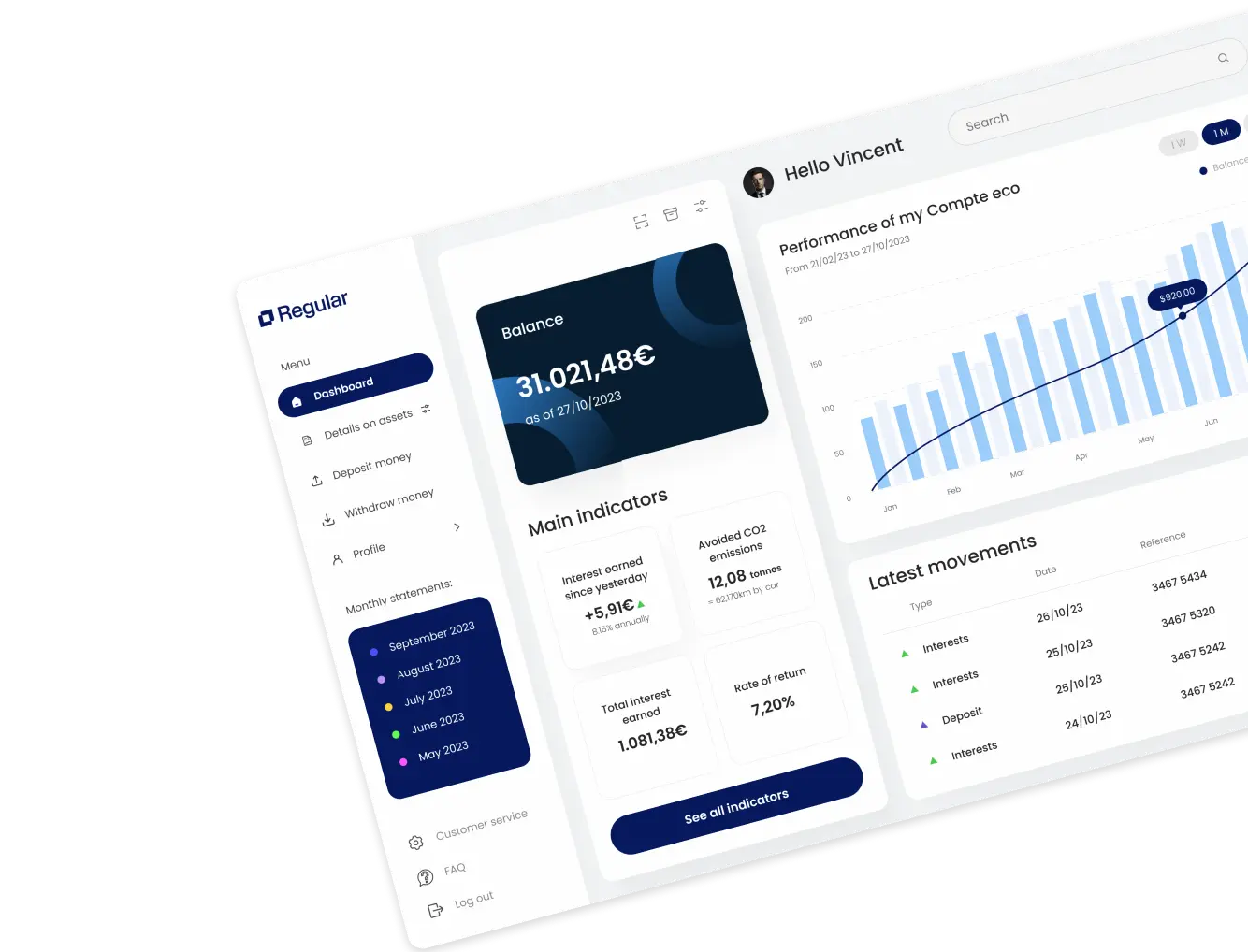
Regular provides businesses with a simple way to benefit from the advantages of stablecoins and decentralized finance, enabling companies to:
- invest simply by euro bank transfer;
- make withdrawals at any time (<72h) and without fees;
- view invested balances through a digital interface;
- access a product framed by French regulation (PSAN status).
This is a different approach from a banking product: the logic is that of a liquid investment, designed to facilitate usability, operational flexibility and the availability of funds.
An operating model based on existing regulation
Regular is not an “outside-the-system” solution. The service operates within a clearly defined French regulatory framework:
- PSAN status registered with the AMF;
- compliance requirements;
- verification and governance procedures.
☁️ Key takeaway
Regular belongs to the category of technology solutions specialized in liquid treasury investment, a new asset class distinct from traditional investment products. It meets a growing demand from businesses: having simple, regulated and flexible services to invest part of their available cash without long lock-up periods or operational complexity.
FAQ – Liquid Investments for Businesses
What is a liquid investment for a business?
A liquid investment refers to a solution that allows a company to recover its funds quickly, without long notice periods or capital lock-up.
These solutions are designed to help businesses keep treasury accessible while potentially generating limited returns on excess cash.
Liquid treasury solutions are commonly used to:
- maintain immediate access to cash;
- finance payroll, suppliers, or operational expenses;
- manage temporary treasury surpluses;
- reduce administrative complexity.
In corporate treasury management, liquidity is often considered more important than pure performance.
Can a company lose capital on a liquid investment?
Yes.
Liquid investments are not automatically risk-free or capital guaranteed.
Risks may come from:
- the issuer or financial counterparty;
- temporary liquidity restrictions;
- market exposure depending on the product;
- regulatory or operational constraints.
Businesses should therefore evaluate:
- the financial solidity of the provider;
- reserve transparency;
- withdrawal conditions;
- the applicable regulatory framework.
A good treasury strategy focuses not only on returns, but also on liquidity and security.
Who can invest company treasury?
Treasury management may be handled by different profiles depending on the company structure:
- CEO or founder;
- CFO or finance department;
- treasurer;
- accounting firm;
- family office;
- external advisor.
The main requirement is having the proper mandate or signing authority.
All types of organizations may manage treasury liquidity:
- SMEs;
- startups;
- holding companies;
- associations;
- scale-ups.
Which investment remains immediately available?
The most liquid treasury solutions generally include:
- business treasury bank accounts;
- interest-bearing accounts;
- certain money market funds;
- certain digital treasury solutions with unrestricted withdrawals.
These products often provide immediate access to funds or withdrawals within 24 to 72 hours depending on the provider.
By contrast, real estate products, structured products or long-term investments may involve exit delays or lower liquidity.
Best practice is always to verify:
- withdrawal timeframes;
- transfer conditions;
- potential penalties or restrictions.
Which treasury solution is the easiest to manage?
Traditionally, current accounts and interest-bearing accounts have been considered the simplest treasury tools to manage.
Increasingly, businesses also rely on digital treasury management platforms because they help:
- reduce administrative workload;
- centralize liquidity management;
- avoid multiplying banking relationships;
- automate treasury operations;
- gain real-time visibility over cash movements.
Most companies typically look for:
- easy onboarding;
- minimal documentation requirements;
- simple operational processes;
- real-time treasury visibility.
 Flexible from day one