Some French holding companies face the same issue today: idle cash that slowly loses value. Between monetary erosion, the low returns of traditional liquid investments, and fiscal complexity, many entrepreneurs leave several points of performance on the table.
New tools, including decentralized finance (DeFi), also offer investment options to optimize a holding company’s treasury, depending on the products and their liquidity conditions.
At Regular, we help executives transform passive cash into a strategic asset.
Objective: maintain control, improve yield, and reduce complexity.
📊 Key points for a holding company’s treasury
- The amount available for investment is determined after allowing for operating needs, scheduled payments and contingencies.
- Inflation in France: +3.4% year on year in October 2026, after +3.1% in September (CPI, final Insee figures published on 13 November 2026).
- French parent–subsidiary tax regime: subject to conditions, dividends are exempt with a 5% expenses add-back subject to corporate income tax, equivalent to 1.25% at the standard 25% rate, excluding special cases.
Summary of the article: how to manage a holding’s cash reserves
French holding companies still leave too much cash sitting idle in current accounts, even though modern, liquid and regulated solutions now exist.
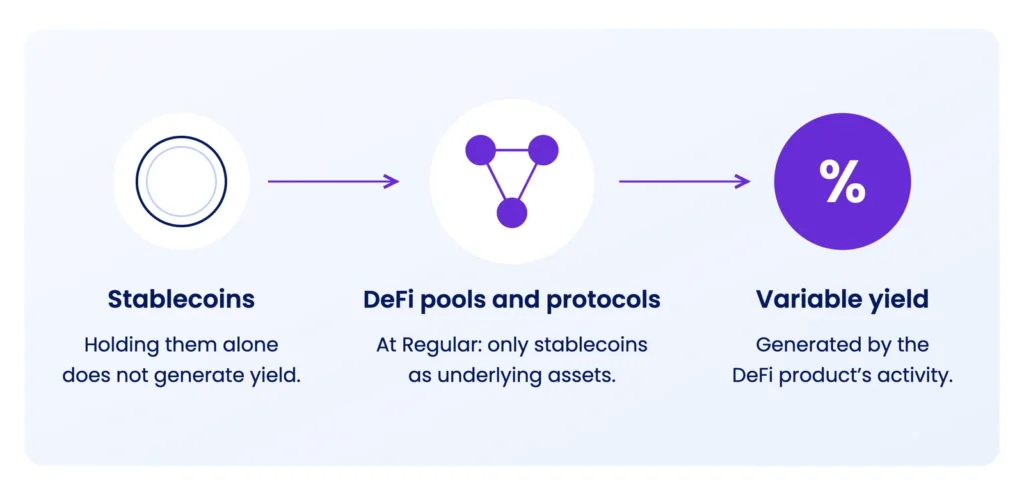
DeFi investments with stablecoin underlying assets, tokenized T-bills and other digital treasury products are distinct solutions, each with its own yield, liquidity and compliance conditions. Holding a stablecoin does not, in itself, generate yield.
An approach to adapt to the holding company’s needs:
- a readily available reserve in stablecoins, with no yield from simply holding them,
- a search for yield through DeFi products with stablecoin underlying assets or, separately, tokenized T-bills,
- controlled diversification via tokenized long-term assets.
Regular supports holding companies with a strategy using DeFi liquidity pools and yield protocols, selecting only products whose underlying assets are stablecoins.
How does a holding company’s cash management work (and why it differs from an operating company)?
A holding company’s cash management follows a logic very different from that of an operating business.
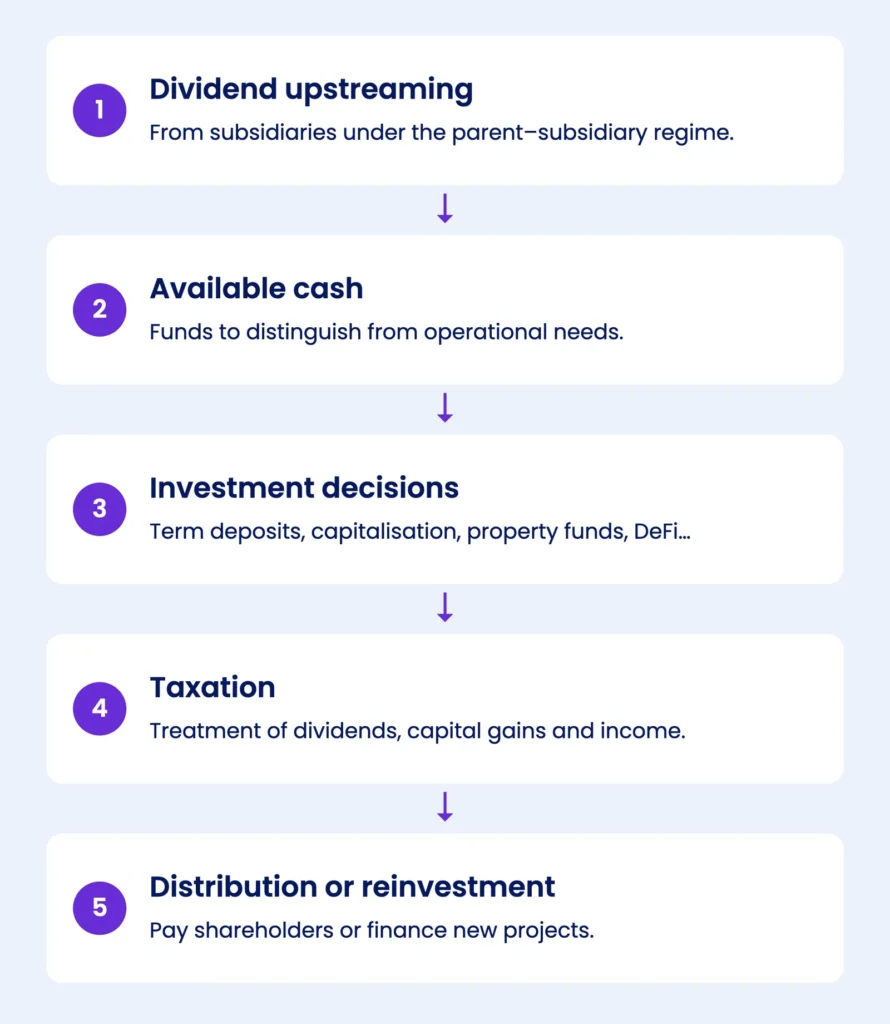
Its primary role is to centralize the group’s financial flows, upstream dividends, manage equity stakes, and optimize taxation (notably through the French mère-fille regime).
Because dividends can be upstreamed with limited taxation under the applicable conditions, and because a holding often has a long-term investment horizon, it has more flexibility to diversify its treasury investments beyond savings accounts or traditional banking products.
It can therefore invest in a wide variety of instruments (financial assets, real estate, private equity, or now tokenized assets) while maintaining a favorable tax framework, as long as the management remains consistent with its corporate purpose.
💡 The 3 questions to ask before investing a holding’s treasury
How much liquidity is truly necessary?
Working capital + contingencies + identified needs = minimum liquidity buffer.
What is the investment horizon?
Short term (0–12 months) / medium term (1–5 years) / long term (5+ years).
What financial needs are foreseeable?
Repayments, acquisitions, growth plans, future dividends, strategic investments.
Traditional options: what works… and where the limits appear
Even though traditional solutions remain relevant in some scenarios, they often come with major limitations for a holding company. Here is a clear and actionable overview.
Term deposit accounts
A long-standing and simple solution for parking corporate cash.
Advantages:
- Capital and rate defined in the contract, subject to withdrawal conditions and the risk of bank default.
- Very clear functioning: fixed term, fixed rate, early exit sometimes possible (with penalties).
- Good option for temporarily immobilizing cash pending future use.
Limits:
- Yield depends on the term, institution and interest rate environment; offers must be compared using dated information.
- To be compared with other solutions based on net yield, risks and exit conditions.
Takeaway: an option for temporarily investing cash, to be compared based on the offered rate and withdrawal conditions.
Capitalization contract (France or Luxembourg)
A widely used tool among holding companies for optimizing taxation, yield, and diversification.
Advantages:
- Specific corporate tax treatment: depending on the contract, annual taxation based on an actuarial rate of 105% of the average French government bond yield (TME) known at subscription, followed by an adjustment on redemption. This is not a complete deferral of taxation.
- Access to a broad range of assets: euro funds, unit-linked products, SCPI, private debt, private equity, structured products…
- Additional optimization possible with Luxembourg policies (super-privilege, multi-currency, access to professional funds).
Limits:
- Medium liquidity: redemptions may involve delays or penalties.
- Potentially high fees depending on the insurer and contract structure.
- Greater complexity: requires strong governance and proper monitoring within the holding.
Takeaway: excellent long-term vehicle, but not optimal for short-term cash or frequent liquidity needs.
SCPI / OPCI (French property funds)
A property investment to consider over the long term.
Advantages:
- Distributions vary by vehicle, with no guarantee of yield or unit value.
- Accessible and diversified compared to direct real estate.
- Can be held within some capitalization contracts.
Limits:
- Weak liquidity: resale can be lengthy or executed at a discount in downturns.
- Conditions vary across SCPIs: some remain exposed to falling valuations or rental pressures, particularly in offices.
- Significant fees: entry, management, transactions.
- Additional decline risk for “classic” SCPI (office, retail).
Takeaway: handle with caution, especially for holdings needing agility and responsiveness.
Securities accounts / listed markets
Flexible solution to invest in liquid financial assets (equities, bonds, ETFs…).
Advantages:
- Generally high liquidity for listed securities, depending on market hours and available counterparties; selling and having the funds available are distinct.
- Wide choice of instruments.
- Strong return potential over the long term.
Limits:
- High volatility in the short term.
- Tax treatment varies by instrument: income and realised gains are taxed under the applicable regime; for certain investment funds, changes in net asset value enter annual taxable income even without a sale.
- Capital loss risk, especially in equities.
- Poor tool for precautionary liquidity.
Takeaway: suitable for long-term portfolios, not for liquidity reserves.
Unlisted assets (Private Equity, private debt, litigation finance)
Top-tier returns… but rarely suitable for a holding’s treasury.
Advantages:
- Potentially high target returns depending on the strategy, with no guarantee of performance.
- Potential diversification away from public markets, with no guarantee of low correlation.
- Strong long-term value creation horizons (5–10 years).
- Certain eligible funds benefit from specific tax treatment subject to conditions, including holding period and asset composition; capital gains are not generally exempt (Article 219 of the French Tax Code).
Limits:
- Low to zero liquidity: locked up for 5–10 years.
- Capital calls spread over time (private equity).
- Complex, opaque selection for non-professionals.
- Capital loss risk depending on the fund.
Takeaway: excellent for long-term family holdings, much less for an “active” treasury or short-term needs.
⚠️ To avoid depending on the context
Some options are simply not suitable for most holdings:
- Direct rental real estate within a holding: heavy taxation, poor liquidity, operational risks (maintenance, vacancies, compliance).
- Classic SCPI during a real-estate downturn: significant downward risk, fragile liquidity.
- Illiquid products with short-term needs: closed-end funds, rigid structured products, primary private equity.
Why DeFi with stablecoin underlying assets is becoming a new option for a holding company’s treasury
Holding companies often end up with idle cash, sitting in current accounts with almost no yield or spread across traditional investments that offer limited performance.
Since 2024–2025, stablecoins have played a growing role in digital treasury flows. They also serve as underlying assets for DeFi products, but holding them and investing in a yield protocol are two distinct operations.
Some stablecoins are backed by reserves of liquid assets, depending on their structure and the applicable framework. These reserves are intended to support their peg: any income earned on the issuer’s reserves is not a return paid to the holder. MiCA prohibits issuers of e-money tokens and asset-referenced tokens from granting interest in relation to those tokens. This prohibition also applies to crypto-asset service providers under the conditions set out in Articles 40 and 50.
What stablecoins and DeFi investments using them actually enable
Transfers available 24/7
Stablecoins can be transferred 24/7, often within seconds depending on the network.
This availability can facilitate flows between subsidiaries or across borders. It does not guarantee immediate withdrawal from a DeFi investment or instant conversion into euros.
Yield generated by DeFi pools and protocols
The yield offered by Regular comes from DeFi liquidity pools or yield protocols. The strategy selects only products whose underlying assets are stablecoins. Remuneration comes from the activity of these products, not from interest paid by the stablecoin issuer. Tokenized T-bills and money market funds are a separate investment category: holding a stablecoin does not give direct entitlement to returns on its issuer’s reserves.
Fees to assess for each service
Network, conversion, protocol and service fees depend on the arrangement:
- network and conversion costs,
- protocol fees,
- service charges to deduct when assessing net DeFi yield.
Smooth fiat ↔ crypto conversion
Providers authorised for the services offered can provide, depending on their offering:
- fiat on-ramp,
- fiat off-ramp,
- transaction tracking and accounting based on the assets actually held.
Distinguishing an available reserve from a yield investment
A stablecoin can serve as an accessible digital reserve, subject to redemption conditions and market liquidity. Seeking yield requires a separate investment, for example in a DeFi pool or protocol. That investment adds technical, liquidity and capital-loss risks. A stablecoin linked to a currency other than the euro also exposes the holding company to exchange-rate risk.
Comparison with traditional investment solutions
| Solution | Liquidity | Yield | Risk | Complexity |
| Term deposit | By contract | Contractual | Bank | Low |
| Capitalisation contract | Exit delays | By asset | Assets / insurer | By contract |
| SCPI / real-estate funds | Limited | Variable | Property market | High |
| DeFi with stablecoin underlying assets | Varies | Variable (DeFi) | Variable | Varies |
📚 Quick reading
- Term deposits are simple, with a return defined in the contract.
- SCPIs have limited liquidity and carry a risk of falling unit values.
- Capitalisation contracts are efficient but not instantly liquid.
- DeFi investments with stablecoin underlying assets may combine variable yield with flexible withdrawals, depending on the protocol. The stablecoin does not reward its mere holding.
🧮 Why distinguish stablecoins from DeFi products?
- Stablecoins target a peg to their reference currency, without guaranteeing it.
- The issuer’s reserves and DeFi protocol security require separate checks.
- The investment horizon depends on the DeFi product’s risks and withdrawal conditions.
- Accounting treatment depends on the assets and rights actually held.
- A stablecoin reserve is distinct from treasury invested in DeFi products.
How to structure an optimized treasury placement
Placing the treasury of a holding company shouldn’t be complicated: the priority is to structure liquidity, manage risk, and optimize taxation.
Regular’s approach uses DeFi liquidity pools and yield protocols with only stablecoins as underlying assets. The applicable framework must be assessed for the service and product concerned; using stablecoins alone does not establish compliance.
A simple & defensible allocation
As a general illustration, a holding company can divide its needs across several allocations. This example does not describe Regular’s allocation and must be adapted to the liquidity required and risks accepted:
40%: Available reserve / stablecoins held
An allocation for liquidity needs, subject to redemption and conversion conditions.
Simply holding a stablecoin does not generate yield. Any DeFi investment is a separate exposure.
30%: Tokenized T-bills & Money Market Funds
Tokenized products providing exposure to short-term instruments (Treasury bills, money market funds). Their yield, risks and liquidity depend on the vehicle; they are distinct from the stablecoins used in Regular’s DeFi strategy.
20%: Tokenized long-term assets
Tokenized private debt, private equity and institutional products accessible in digital form. Tokenization does not guarantee their liquidity.
Objective: capture yield without compromising governance.
10%: Opportunity / strategic reserve pocket
To seize market opportunities, reinforce a position, or absorb stress periods (markets, rates, short-term needs).
The 5 principles of a well-managed holding treasury
- Security first: examine stablecoin reserves, DeFi protocols and custody conditions.
- Smart diversification: short term / long term / tokenized exposure.
- Controlled liquidity: avoid locking up all available cash.
- Optimized taxation: French parent–subsidiary regime and specific tax treatment for eligible products.
- Compliance & governance: procedures, regulated providers, full traceability.
Building a strategy suited to the holding company
Traditional solutions (term deposits, capitalization contracts, SCPI, PE…) remain useful but show clear limits: insufficient yield, low liquidity, heavy taxation, or operational complexity.
DeFi products with stablecoin underlying assets and tokenized financial products offer other possibilities, whose mechanisms must be distinguished:
- liquidity that varies by product and exit conditions
- a regulatory framework to assess for each service and product
- yield generated by DeFi pools or protocols, or by separate tokenized instruments
- integration into accounting & banking systems to arrange
- network, protocol and service fees to compare
For a holding company, the value of these solutions depends on its treasury needs, the risk accepted and the governance in place.
Regular’s added value
- institutional-grade crypto/fiat expertise
- selection of DeFi products with only stablecoins as underlying assets
- analysis of issuers and reserves
- operational setup (wallets, processes, reporting)
Regular offers exposure to selected DeFi liquidity pools and yield protocols, with only stablecoins as underlying assets. Yield is not paid by the stablecoin issuers; it comes from the DeFi products and remains subject to their risks.
 Flexible from day one