Yield in DeFi is often presented as a promise: double-digit APYs, passive income, alternatives to traditional savings. The reality is more complex.
The yields advertised can come from interest, transaction fees or token emissions. These rewards are real, but their sources do not all offer the same staying power or level of risk.
The aim of this article is not to recommend a platform or strategy, but to understand how DeFi yield actually works and what allows it to last.
⚠️ Disclaimer
This guide is in no way an invitation to invest. Investments in digital assets carry a risk of capital loss. Certain forms of remuneration on stablecoins are regulated or prohibited, depending on the service, provider and jurisdiction involved.
Article summary – DeFi yield
- DeFi yields do not all have the same source or staying power.
- Interest, fees and token emissions can all reward users. Launch incentives are generally temporary.
- Stablecoins limit the volatility of the underlying asset, but risk also comes from reserves, liquidity and the legal framework.
- The key question is: where does the yield come from, and can it be maintained?
- DeFi yield depends on the protocol’s economic model, governance and security.
DeFi, APR, APY and the sources of yield
DeFi yields can be funded by revenue from the service or by token emissions. Understanding their source helps assess whether they can last, without drawing a distinction between “real” and “artificial” yield.
What yield in a DeFi protocol really means
DeFi yield generally rewards a service provided to a protocol:
- capital lent to other users;
- liquidity supplied to a market;
- participation in securing a network.
Additional rewards may supplement this remuneration to encourage use of the protocol.
Yield funded by protocol revenue
A protocol can reward users through trading fees, lending interest or commissions on financial transactions and payments.
This yield may last longer when the service is used regularly. It remains variable: less borrowing or trading reduces the revenue distributed.
Yield funded by token emissions
Some platforms distribute their own token to attract users and build liquidity. This is real yield and an incentive mechanism that can, in particular, support the launch of a protocol, within the applicable rules.
Its limitation is how long it can last. A launch campaign cannot be assumed to continue indefinitely:
- distributions may decrease or stop;
- new emissions may dilute existing holders;
- the value of the tokens received may fall quickly under selling pressure.
It is therefore necessary to distinguish the yield generated by the protocol’s activity from the temporary extra rewards provided by incentives.
📌 Key takeaway
Yield supported by recurring revenue may last longer. Yield funded by token incentives is real, but its duration and value need to be examined.
APR and APY: the difference explained simply
APR, or “Annual Percentage Rate”, is an annualised rate that does not include reinvesting the interest received (earnings). APY, or “Annual Percentage Yield”, includes reinvestment: the interest itself earns further interest. This is compounding.
With €1,000 invested at a constant APR of 10% for one year, the gain is €100 without reinvestment. If interest is paid each month at that 10% APR and compounded, the gain reaches €104.71, equivalent to an APY of 10.47%.
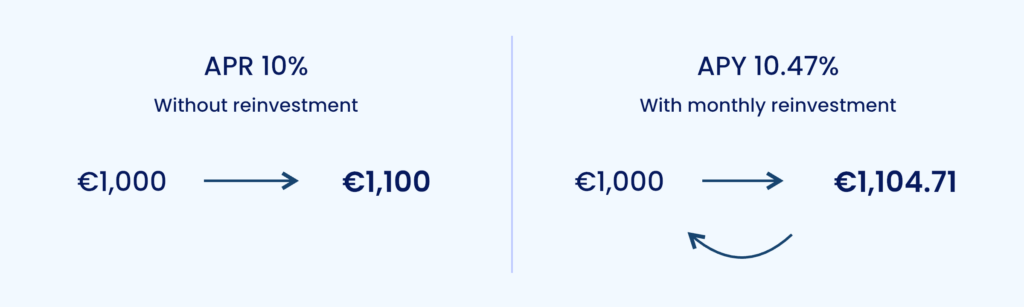
APY assumes that the rate and reinvestment conditions used in the calculation are maintained. It may include token rewards; it is not a guaranteed gain.
The main mechanisms behind crypto yield
Most protocols rely on a few straightforward, identifiable models. Each can combine revenue from activity with additional rewards.
Lending / borrowing
The protocol connects lenders and borrowers. Interest is paid by users who borrow to trade, arbitrage, take on leverage or fund a position. Here, yield comes from use of the protocol.
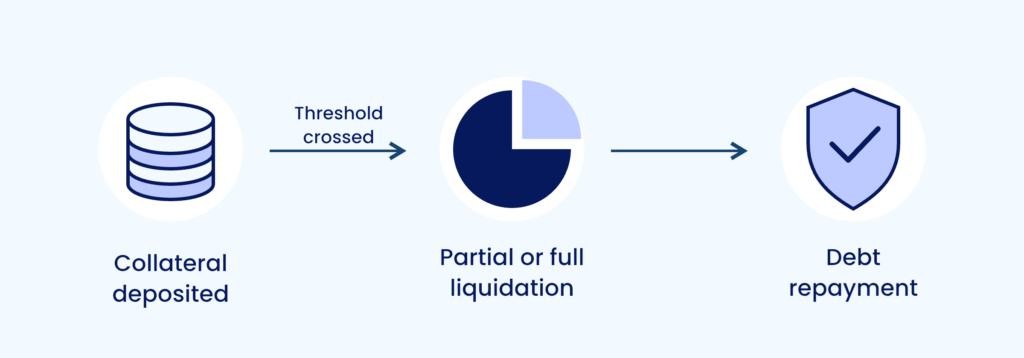
In major overcollateralised lending protocols, borrowers must deposit assets as collateral worth more than their loan. If the value of these assets falls past a threshold, they may be liquidated in stages to repay the debt and protect lenders. Full liquidation is also possible.
Like a secured loan in traditional finance, this mechanism substantially reduces the risk of non-payment. A sudden price fall or failed liquidation may nevertheless leave some debt uncovered. Technological risk remains.
Liquidity providing (LP)
A liquidity provider generally deposits two assets into a pool to enable trading. Yield comes from the transaction fees generated by swaps and depends on use of the pool.
This model involves technical risk (smart contracts), as well as a specific risk: impermanent loss. Price movements can make the position less profitable than simply holding the assets, despite the fees earned.
Native staking or revenue-based protocols
Native staking rewards participation in validating a proof-of-stake network. Rewards may combine new token emissions with a share of network fees.
Other protocols redistribute internal revenue from fees or economic activity. Emissions intended to secure a network therefore do not have the same time horizon as a launch campaign.
⚠️ No platform or protocol is recommended here: the aim is to explain the mechanisms, not to recommend a financial tool.
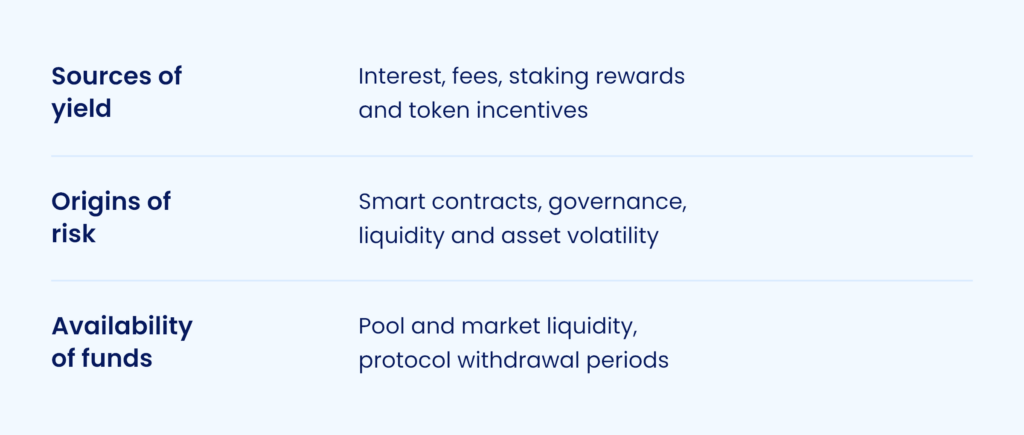
DeFi yield ≠ guaranteed returns
Yields advertised in DeFi are generally variable and do not guarantee performance. An APY is only a snapshot at a given moment, calculated using current conditions: volume, protocol usage, demand for borrowing, ongoing emissions… There is no guarantee that the rate will stay the same over time, or that the result will be positive in euros.
Several factors can change the yield, sometimes very quickly.
The sustainability of the model
Yield funded by temporary incentives may drop sharply when the campaign ends or if the token loses value. Revenue from fees and borrowing, meanwhile, depends on demand for the service.
Market volatility
DeFi yield may come from investing in cryptocurrencies that are volatile, such as Bitcoin or Ether, or in stablecoins. Bitcoin is often used through a tokenised representation, which carries risks specific to that arrangement.
Gains in tokens can be wiped out by a fall in their price. With stablecoins, yield is less exposed to movements in the underlying asset as long as the peg holds. Depegs, changes in collateral values or cascading liquidations may nevertheless affect the position. A yield of 8–10% can therefore be offset by a loss in value.
Liquidity risks
DeFi often offers high liquidity: a lending deposit or a pool position can generally be unwound without a minimum holding period, as soon as the transaction is confirmed. The exit is then almost instantaneous.
However, this availability depends on the protocol. In lending, enough funds must remain unborrowed. A surge in withdrawals, reduced market depth or a technical suspension can make exiting more difficult. Staking may also involve waiting periods. Finally, recovering tokens and converting them into euros are two separate operations.
Technical and governance risks
A smart contract bug, a manipulated oracle, governance captured by a handful of participants or a poorly designed update can destroy some or all of the value. The protocol may be drained, its economic model altered or its distribution rules changed.
❗️ Real yield is not necessarily lasting yield
Its ability to last depends on revenue or emission rules, liquidity and risks. A temporary reward is still remuneration, but it does not constitute permanent income.
The role of stablecoins in DeFi
Stablecoins play a central role in DeFi. Their yield comes from how they are used: trading, borrowing or protocol operations, rather than simply holding them.
Their peg to a currency limits the volatility of the underlying asset. However, a dollar stablecoin exposes an investor whose reference currency is the euro to exchange-rate risk.
Risk therefore comes not only from the DeFi protocol, but also from the type of stablecoin used. Beyond the advertised rate, the critical points to examine are:
- the quality and transparency of the assets backing the stablecoin’s value (the collateral);
- the safekeeping and custody of funds;
- market depth and redemption conditions;
- the regulatory framework.
DeFi yield is therefore not just a technical matter: it is also a question of governance and compliance.
Comparison table
| Point to examine | Reserve-backed stablecoin, regulated issuer | Stablecoin outside the locally applicable framework | Algorithmic stablecoin without sufficient reserves |
|---|---|---|---|
| Reserves | Requirements for composition, protection and oversight | Quality and transparency to be checked | Stability depends on the mechanism and demand |
| Supervision | Obligations defined by the jurisdiction | Protections and legal recourse vary | The mechanism alone does not determine legal status |
| Liquidity | Must be checked on each market, even with a regulated issuer | Depends on markets and redemption conditions | Can deteriorate rapidly under stress |
| Risk to monitor | Issuer failure, depeg, exchange-rate risk | Reserves, counterparties and compliance | Loss of the peg and a spiral of declining confidence |
Regulation, reserves and the stabilisation mechanism are separate criteria; none on its own guarantees the investment.
What regulation says (MiCA, GENIUS Act)
Regulatory frameworks influence the products available, providers’ obligations and certain forms of remuneration.
MiCA (European Union)
The MiCA regulation covers, in particular:
- issuers and crypto-asset service providers;
- transparency and obligations relating to reserves;
- client protection and custody;
- the prohibition on the issuers and providers concerned paying interest linked to holding certain stablecoins.
Article 50 of MiCA specifically addresses e-money tokens. This rule does not amount to a blanket ban on all DeFi yields: the service and its structure must be examined.
Many DeFi protocols are not regulated as intermediaries. Fully decentralised services without an intermediary fall outside MiCA’s scope; however, each case needs to be assessed individually.
By contrast, accessing these protocols through a provider offering regulated services, such as custody, exchange or management, requires that provider to hold the corresponding authorisation. In France, the MiCA transitional period ended on 1 July 2026. Providers offering crypto-asset services within MiCA’s scope must now hold the corresponding authorisation. It does not guarantee the capital or the protocols used.
GENIUS Act (United States)
Adopted on 18 July 2025, the GENIUS Act sets out a framework for payment stablecoin issuers, including:
- reserves covering at least 100% of the stablecoins issued, consisting of permitted, liquid assets;
- monthly disclosures and checks on reserves;
- federal or state-level supervision, depending on the circumstances;
- a prohibition on the issuers concerned paying interest or yield directly to stablecoin holders solely for holding the stablecoin.
Its implementation follows the timetable set out in the law and its implementing rules. This framework covers payment stablecoins; it does not guarantee DeFi investments that use them.
⚠️ Important – regulatory framework
Certain forms of yield are restricted or subject to conditions depending on the jurisdiction. It is necessary to distinguish the remuneration of the stablecoin from that of a DeFi service, and to consider the provider’s role. This guide is for information only; it does not promote investment or encourage you to invest.
How to assess DeFi yield
Understanding yield in DeFi does not require you to be a blockchain developer. The real question is not “how much?” but where the yield comes from, and whether it can last.
Three straightforward criteria help structure the assessment.
1. What is the source of the yield?
Identify the share coming from interest, fees, validation rewards and token incentives. Check which asset the rewards are paid in and how the advertised rate is calculated.
2. Is the model sustainable?
Stability depends on demand for the service, liquidity and distribution rules. Check when promotional rewards end: a temporary rate cannot be extrapolated over the long term.
3. What protections underpin the yield?
Examine protocol risk, assets, borrowers’ collateral and governance: who controls what? Audits reduce some risks without eliminating them.
⚡️ Quick checklist for assessing DeFi yield
✔ What is the source of the yield, and how much comes from temporary incentives?
✔ Is the rate an APR or an APY, and which fees still need to be deducted?
✔ Which asset is used: a volatile cryptocurrency or a stablecoin? With what reserves?
✔ Has the protocol been in use for a long time, and has it weathered periods of stress?
✔ Is there enough liquidity, and how long does it take to exit?
✔ Does the provider hold the necessary authorisations?
The risks to be aware of
DeFi yields are not just a financial equation. They rely on several layers of risk that interact with one another.
Technical risks. Smart contracts, bugs, hacks, faulty oracles, poor governance or problematic updates. An audit does not guarantee the absence of vulnerabilities.
Protocol risks. Dependence on a pool’s liquidity, borrowing demand and trading volume; the risk of insufficient liquidation in lending and impermanent loss in LP positions.
Risks linked to assets and stablecoins. Falls in the price of cryptocurrencies or distributed tokens, insufficient reserves, lack of transparency, depegs and exchange-rate risk can reduce capital or gains.
Regulatory risk. The provider’s status, the conditions under which the product is distributed and restrictions on remuneration may affect access to the service or how it operates.
To sum up
Interest, fees, network validation or token emissions: these rewards are real, but their ability to last differs. A launch incentive can serve a temporary purpose without becoming a lasting source of income.
The key issue is not the APY a protocol advertises, but where that yield comes from, how it is generated and under what conditions it can be maintained. Understanding the models, risks and regulatory limits helps assess a rate beyond the number alone.
🧊 In brief
DeFi yield depends on economic mechanisms, asset quality, liquidity, compliance and security. Understanding its source helps assess whether it can last.
 Flexible from day one